



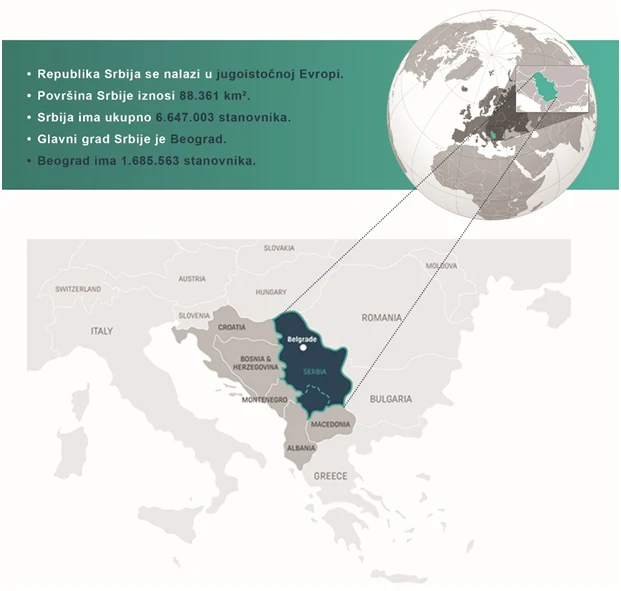
Position of Serbia on the map of the world and southeastern Europe
GENERAL AND SPECIFIC CHARACTERISTICS OF THE AREA
BROADER CONTEXT OF THE COMPETITION SITE
The Republic of Serbia is located in southeastern Europe, in the central part of the Balkan Peninsula. Serbia covers an area of 88,361 km2, and its strategic position makes it an important hub for trade and transportation in the region.
Serbia borders eight countries: Hungary to the north, Romania to the northeast, Bulgaria to the southeast, North Macedonia to the south, Albania and Montenegro to the southwest, and Bosnia and Herzegovina and Croatia to the west. This position enables Serbia to engage in diverse cultural and economic interactions, while its proximity to the EU and other markets opens numerous opportunities for development.
According to the latest population census from 2022, Serbia has a total population of 6,647,003 inhabitants, the majority of whom are concentrated in urban areas such as Belgrade, Novi Sad and Niš.
Serbia is known for its cultural diversity, which includes various ethnic groups and languages, contributing to its rich traditions and cultural heritage. Its demographic structure, together with natural resources, makes Serbia a country with great development and investment potential.
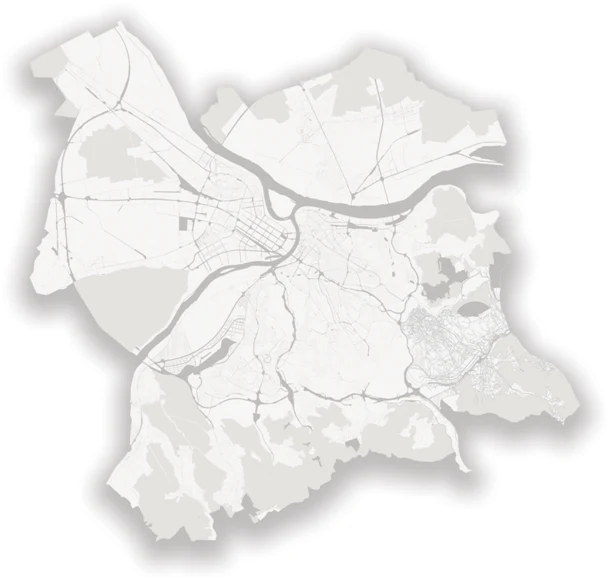
Belgrade (Area: 3,222.68 km2)
CITY OF BELGRADE
Belgrade, the capital of Serbia, occupies a significant geographical position in southeastern Europe. It lies on two rivers – the Sava and the Danube – which surround it on three sides. Belgrade is located at the crossroads of important European routes and corridors, including the east-west route along the Danube River from Vienna to the Black Sea, the western route along the Sava River valley toward Trieste and northern Italy, and the southeastern route through the valleys of the Velika Morava, Južna Morava and Vardar rivers toward the Aegean Sea. This position makes Belgrade a strategically important city in the region.
Belgrade is among the older European cities, with archaeological sites dating back to the fifth millennium BC. The Celtic tribe founded Singidunum in the 3rd century BC, while the first recorded mention of Belgrade dates back to 878 AD. Throughout its long and turbulent history, Belgrade was conquered as many as 40 times and rebuilt from ruins 38 times on the plateau between two rivers, as evidenced by its many architectural layers.
Belgrade is a city of rich history, culture and architecture. Every war in its history left behind ruins that always inspired new waves of construction and urban renewal. Every new building, street and monument testifies to the indestructible spirit of Belgrade.
Belgrade has diverse topography, with plains along the banks of the Sava and Danube rivers and hills and elevations south of these rivers in the Šumadija region. The total length of Belgrade’s riverbanks is approximately 200 km. Within this area there are 16 river islands, the most famous being Ada Ciganlija (today a peninsula), Great War Island and Gročanska Ada.
According to the 2022 census, Belgrade has around 1,685,563 inhabitants in the wider urban area, making it the largest city in Serbia and one of the larger cities in southeastern Europe. Belgrade is a dynamic city with a continuous influx of residents from other parts of Serbia and the region, contributing to its multicultural character.
Belgrade is the main educational center of Serbia, with numerous universities, schools and research institutes. It is also the key political, economic and cultural center, with developed manufacturing and IT industries, trade and services. Due to its educational, economic, cultural, historical and many other advantages, Belgrade is attractive to new residents.
Belgrade is a city of rich cultural heritage with around 40 museums preserving valuable collections and documenting the artistic, cultural-historical, technical and natural-historical development of the city and Serbia. Belgrade’s museums, with their thematic exhibitions, rich collections and large number of representative artifacts, attract visitors of different ages and educational backgrounds, including both Belgrade residents and tourists wishing to become acquainted with the culture of the Serbian people during their visit.
Through their collections, museums in Belgrade preserve cultural and scientific treasures that testify to how the city was created, the times in which it developed and the circumstances of its growth, providing visitors with insight into various historical and developmental periods of the country.
Belgrade is a highly urbanized city with diverse urban structures of different character. The central parts of the city, oriented toward the right banks of the Sava and Danube rivers, are densely populated and highly urbanized, while the middle and peripheral areas offer more open space and greenery within organized residential neighborhoods.
Belgrade, situated on two major rivers, has still not fully utilized its riverbanks. The first urbanized public spaces and landscaped promenades along the rivers were developed in New Belgrade and partly in the central zone. Therefore, new projects aim to maximize the potential of the rivers. The city’s continuous expansion toward the riverbanks and the connection of publicly accessible spaces are planned, allowing Belgrade to finally realize its full potential as a city oriented toward its rivers.
In recent decades, Belgrade has undergone dynamic development, particularly in the field of construction. Many parts of the city have experienced complete transformation through the construction of modern complexes that have significantly altered the traditional appearance of the city. Among the most significant projects is “Belgrade Waterfront,” an ambitious urban and construction development project along the banks of the Sava River. This project not only changes the visual identity of the city but also influences its economic and social development.
The project began in 2014 with the aim of improving the urban riverfront landscape through the revitalization of the neglected Savamala area in central Belgrade into a modern, multifunctional urban center.
The project includes the construction of luxury residential and commercial buildings, hotels, shopping centers, educational institutions, cultural facilities, recreational zones and green areas within the Sava Amphitheater area, between the Belgrade Fair and Branko’s Bridge.
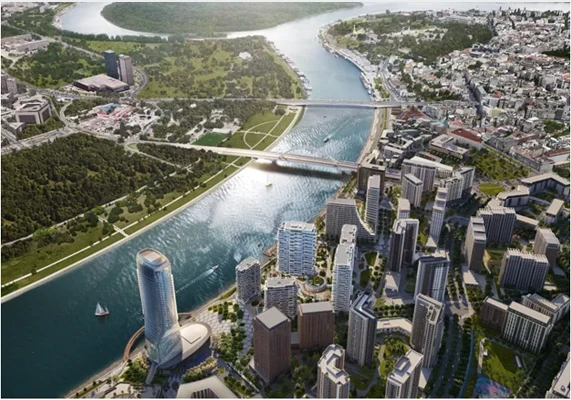
“Belgrade Waterfront” Project
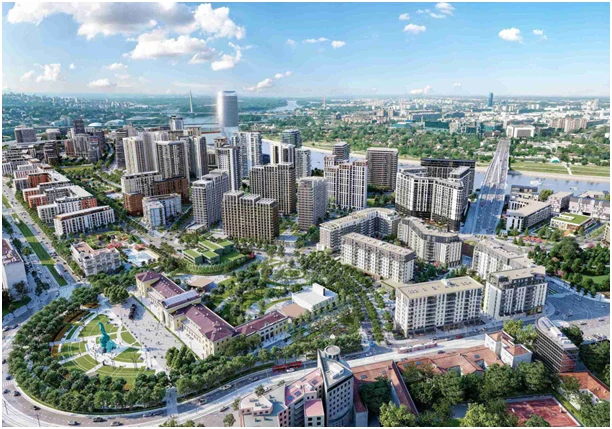
“Belgrade Waterfront” Project
The competition site is located in the central zone of Belgrade, on the right bank of the Sava River within the Sava Amphitheater. In terms of urban characteristics, position, typology, monumental, environmental and other values, this area represents a highly complex and attractive part of Belgrade. From the perspective of cultural heritage, it holds exceptional value for the culture and identity of the city, considering that the wider surroundings contain a large number of protected cultural assets and heritage sites documenting the history of Belgrade and the Republic of Serbia.
Until recently, the competition area included part of the complex of Belgrade’s main railway station, which has been relocated to “Prokop,” as well as part of the bus station, which has been relocated to Block 42 in New Belgrade.
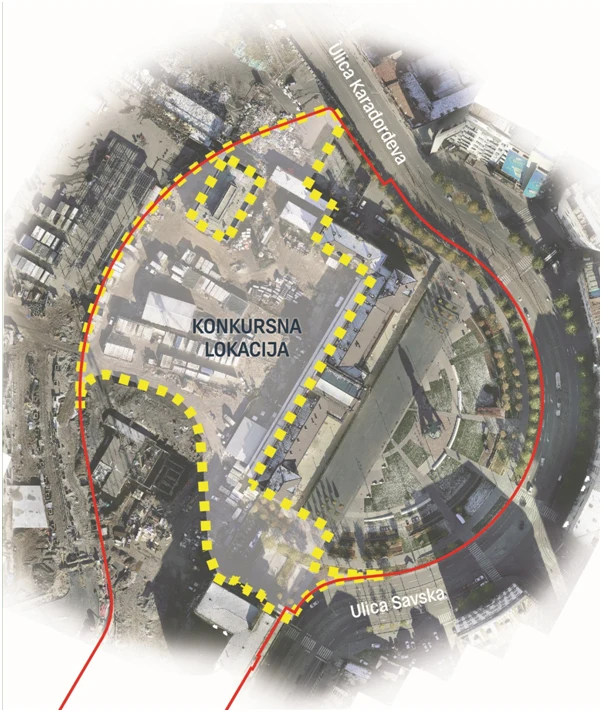
The section of Savski Square behind the “Old Railway Station” building (Historical Museum of Serbia), where railway platforms and auxiliary facilities of the Belgrade railway station were located prior to the beginning of the “Belgrade Waterfront” project, will be spatially completed following the construction of the planned SAO 6 road (Luke Ćelovića Trebinjca Street) and the campus of educational institutions defined by the PPPPN BNV.
The section of Savski Square that is the subject of the Competition is bordered on two sides by representative examples of Belgrade’s architectural heritage – the “Old Railway Station” building (Historical Museum of Serbia) and the “Old Post Office” building (Archaeological Museum of Serbia). The competition site forms a unique spatial and functional entity together with the area in front of the “Old Railway Station” building and the section of Savski Square shaped by the curved regulation line of Savska Street.
During 2018, an urban and architectural competition was announced with the goal of landscape and ground-level arrangement of Savski Square in front of the “Old Railway Station” building, in order to enable a functional, high-quality and content-rich stay in the open public urban space.
Based on the winning proposal (Fenwick Iribarren Architects from Madrid), this section of Savski Square was reconstructed and opened in January 2021. The central part of the square is occupied by a monument dedicated to Stefan Nemanja, founder of the Serbian state, designed by Aleksandr Rukavishnikov. The monument is 23 m high and contains an open museum within its pedestal. The square received a completely new appearance and a pedestrian zone of around 20,000 m2 with 300 newly planted trees.
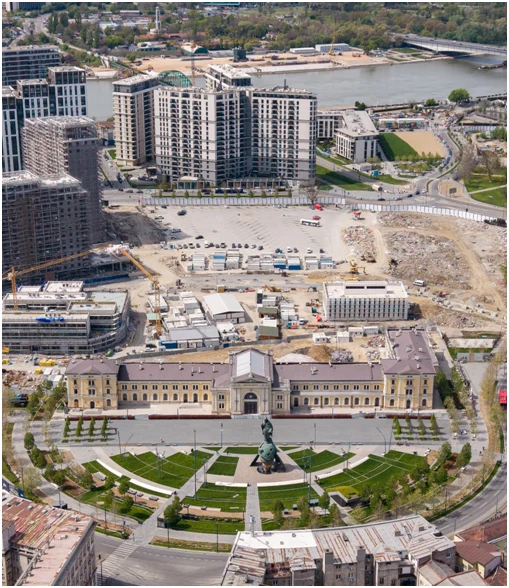
Along the planned SAO 6 road (Luke Ćelovića Trebinjca Street), on part of cadastral plot 1508/433 KO Savski Venac, the 110/10kV transformer station TS “Belgrade 47 – Belgrade Waterfront,” with basement + ground floor + first floor, has been constructed in accordance with the PPPPN BNV.
In the space between the “Old Railway Station” building (Historical Museum of Serbia) and the “Old Post Office” building (Archaeological Museum of Serbia), there is the “Blue Train” locomotive – a special train used by former SFR Yugoslavia president Josip Broz Tito. The interior was designed in the Art Deco style and has remained unchanged for more than half a century. The “Blue Train” was in use from 1946 to 1980. The “Blue Locomotive” is steam locomotive JŽ 11-022, one of the first locomotives to pull the “Blue Train” from March 27, 1947, throughout the following decade. It was manufactured in 1947 at the “Mavag” factory in Budapest. It belongs to the group of express steam locomotives and reached speeds of up to 90 km/h. The locomotive with its coal tender is approximately 21 m long. This steam locomotive is the only preserved example in Serbia and belongs to the technical collection of the Railway Museum. It was placed at its current location in 1984. The “Blue Locomotive” was designated as a cultural asset by the Decision of the Museum of Science and Technology No. 164/7 dated November 3, 2022.
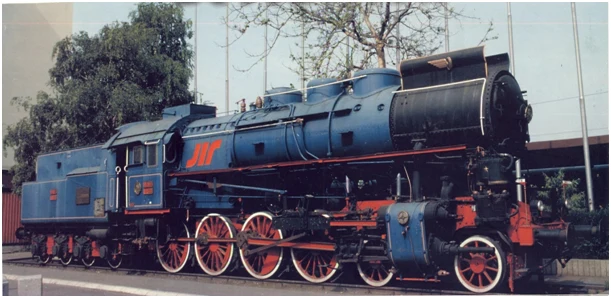
“Blue Train” Locomotive
The “Old Railway Station” building on Savski Square will be repurposed into the exhibition space of the Historical Museum of Serbia, covering 3,000 m2. The exhibition area includes the ground floor and first floor, where the complete history of Serbia will be presented in one place.
The Historical Museum of Serbia is an institution that collects, preserves, studies, professionally and scientifically processes material evidence of Serbian history, maintains and expands museum collections as well as information and documentation about them, and makes them accessible to the public. The museum’s task is also to responsibly and professionally articulate and interpret knowledge about the past of Serbia and the Serbian people, as well as other peoples and cultures within the territory of Serbia, through museum exhibitions and communication with the public regarding the national historical heritage.
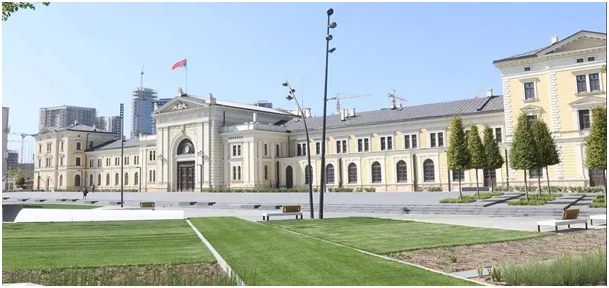
Old Railway Station, 2024
The “Old Post Office” building in Savska Street – according to the current reconstruction and repurposing project, the return of its authentic architectural appearance and form from 1929 (designed by architect Momir Korunović) is planned. Through the planned repurposing, the building will be adapted to the needs of the future Archaeological Museum of Serbia.
The street frontage of Karađorđeva Street – the section from Lička Street to Mihaila Bogićevića Street is visible from certain points of the square. In the current condition, this frontage consists predominantly of commercial buildings ranging from ground floor to ground floor + 2 floors, of poor quality. At the corner positions of this block toward Lička Street and Mihaila Bogićevića Street there are commercial buildings with ground floor + 7 floors + penthouse, of good quality.