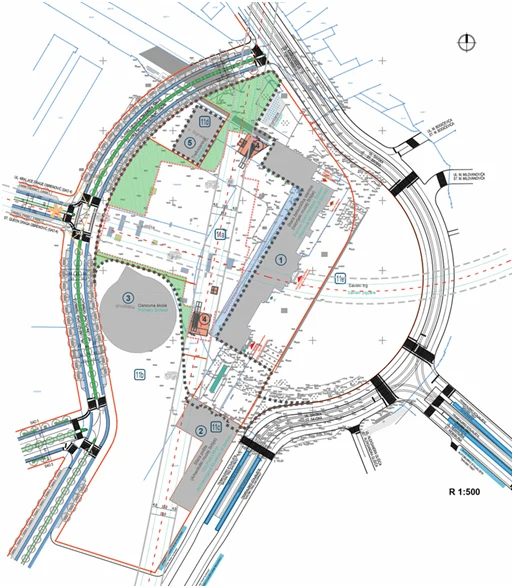
The subject of the Competition is the program architectural & urban solution for landscaping of Savski Square open space behind the Old Railway Station (Historical Museum of Serbia).
The Competition Brief should offer a functional conceptual design of the open space – the square, which represents a free space behind the protected cultural property and includes pedestrian accesses to the building, metro station accesses, greened and paved areas consistent with its significance and program requirements. Also, by the Competition Solution it is necessary to form an ambience that is affirmative with regard to the context and high cultural and historical values of the area.
In view of the significance of the Competition Site, its position in the urban tissue and the status of the existing Old Railway Station Building (Historical Museum of Serbia), a special task is set before the competitors who are expected to commence preparation of their Competition Solutions with special skill and affinity.
The task before the competitors is, with their conceptual designs of square landscaping, to create a correlation with the already completed solution of landscaping of Savski Square in front of the Old Railway Station Building (Historical Museum of Serbia), and at the same time to achieve that this part of the square gets a unique identity. Furthermore, it is necessary in an original and authentic way to emphasize the monumental and architectural characteristics of the existing Old Railway Station Building (Historical Museum of Serbia) and/or its façade the square is corresponding with.
It is necessary to create a solution for the square which will have at the same time a modern mark blending with the architecture of new buildings in the surrounding and, on the other hand, a traditional artistic expression in harmony with the façade of the protected building mirroring in it.
Cultural and historic values of the area should be treated as a resource, a source of identification and cultural capital that represents one of the fundamental elements of spatial and urban development. The landscaping solution should affirm urban continuity and enable integrative protection of cultural heritage.
The square area should be planned as a unique unit, without fencing – the area should be functional, dynamic, innovative and artistically designed so to provide to its users a striking experience of movement through a new completely transformed part of the city, and at the same time to be recognizable in a wider urban and social framework of Belgrade.
Solution of free and green spaces should be adjusted to the needs of the planned contents in the surrounding and to frequent user movements expected after construction of Savski Trg Metro Station, as well as to the educational and cultural contents in the immediate vicinity.
When defining Competition Solutions, the following general guidelines and recommendation should be observed:
- Plan the square area with various contents – dynamic, attractive and appealing to different groups of users during different parts of a day and throughout the entire year;
- Plan a multifunctional and flexible space for everyday regime of functioning, but also for different events and manifestations which will be held occasionally or periodically;
- The project of Savski Trg Metro Station should be implemented into the conceptual design of the square. Entrances into metro station and elevators will be made in compliance with the Architectural Branding Manual, which is an integral part of the said project;
- With the Competition Solution it is necessary to make a connection with the design elements from project documentation in the square’s surrounding in order to create a spatial unit of unique artistic expression;
- Architectural and urban concept should be in accord with the site location relative to the city center and founded on appreciation of historic, natural, cultural and social significance of this area. Future interventions must be planned in such a way not to imperil cultural and historical identity and artistic values of the areas covered by the Competition;
- Differentiate certain segments of the square through esthetics and function of each microambience: spatial dominant, greenery, water, metro station accesses, stopping points, etc.;
- The square area should be observed as a unique unit with already completed part of Savski Square along Savska Street and the Old Railway Station Building, which represents cultural property of great importance for the Republic of Serbia, and whose reconstruction and repurposing into the Historical Museum of Serbia are planned. With its new function this building defines the character of open public space of the square, generates gathering of different types of users and completes this part of the city with the contents of culture, education, tourism and similar urban functions. Competition Solution should emphasize the existing character and value of the cultural monument in the ambient & artistic and cultural sense;
- Connection of the square with Savska Street should be solved so as to correspond to the planned solution of the Old Post Office Building (Archeological Museum of Serbia), taking into account that the new design will restore the authentic look (before the Second World War) to the building, thus enabling historical continuity;
- Continuity of the planned contents along the street SAO6 (Luke Ćelovića Trebinjca) to be taken into consideration. Some of these contents are already implemented, whereas for other contents production of urban and project documentation, preparation for implementing the final phase of implementation – Educational Campus (elementary school and kindergarten), Old Post Office (Archeological Museum of Serbia), transformer substation, etc. are in progress.
- Apply modern tendencies in architecture, landscape architecture and design of public spaces, without imitating historic styles;
- Plan maximally possible percentage of green spaces in direct contact with the soil (without underground levels and/or structures), thus ensuring ecological functionality of green spaces and favorable effects on urban climate in the heat island zone.
- Spatial and functional organization of the square must be clear, logical and presented though movement pattern in order to illustrate connection between different zones and contents;
- When defining levelling of the square (some square segments) it is necessary to perceive the site in the context of the surrounding public streets and the part of Savski Square in front of the Old Railway Station Building (Historical Museum of Serbia);
- Square accesses and/or traffic and pedestrian communications should be clear, logical, available to all user categories (persons with disabilities, elderly, persons with small children) and adequately equipped with the elements of urban and information furniture;
- Square area should integrate all types of traffic movements (pedestrian, cycle, flows of delivery and emergency vehicles, etc.) and planned free and green spaces into an attractive functional and ambient unit;
- When defining the Competition Solution care should be taken of the requirements of infrastructure equipping of the site and/or connecting to the utility infrastructure – power, telecommunication, water supply, sewage, etc.;
- Quality and type of materialization should illustrate the significance and representativeness of the space, thus it is necessary to plan durable, high-quality materials, resistant and safe for use in all weather conditions. By materialization, type and way of paving, shaping the open spaces, introducing greenery and directing the views and movement flows it is necessary to form the square as a recognizable visual dominant in the mental map of this part of the city;
- Care shall be taken to protect the structural system of the underground “Savski Trg” Metro Station – the elements of the square’s ground-level arrangement must not endanger the reinforced-concrete structure of the station or cause any additional adverse loads upon it. Concentrated and permanent high-mass loads that may cause additional deformations or other unfavorable impacts on the structural system of the underground facility should be avoided.
- Enable clear visibility of the square from all access directions taking into consideration terrain configuration and spatial distribution of the built structures. Special care to be taken of the view from the direction of the Sava riverside area, along the street SAO 4 (Kraljice Drage Obrenović) wherefrom the square, Old Railway Station Building (Historical Museum of Serbia) and the silhouette of the urban core with the Beograđanka Palace as a spatial dominant are viewed;
- Care should be taken of safety of the space for different user groups – space visibility, lighting, safety equipment, etc.;
- Ensure certain level of solution flexibility in order to make it possible to adjust it with other functional and contents-related requirements during further elaboration;
- Care should be taken of the planned routes of infrastructure lines, as well as of the existing ones that are retained;
- Provisions of effective laws and rulebooks of the Republic of Serbia to complied with during preparation of the Competition Solution:
- Law on Planning and Construction (Official Gazette of the Republic of Serbia, Nos. 72/09, 81/09, 64/10 – Constitutional Court (CC) decision, 24/11, 121/12, 42/13 – CC decision, 50/13 – CC decision, 98/13 – CC decision, 132/14, 145/14, 83/18, 31/19, 37/19-other law, 9/20, 52/21, 62/23 and 91/25),
- Rulebook on the Content, Method and Procedure of Production and the Method of Control of Technical Documentation according to the Class and Purpose of Facilities – Basic Provisions (Official Gazette of RS, No. 96/23),
- Law on Fire Protection (Official Gazette of RS, Nos. 111/09, 20/15 and 87/18 – other laws),
- Rulebook on Technical Standards of Planning, Designing and Construction of Buildings which ensure Unhindered Movement and Access of Persons with Disabilities, Children and the Elderly (Official Gazette of RS, No. 22/15), and other regulations and standards.
For defining Competition Solution observe also Planning Requirements provided in Chapter 5 Requirements of Planning and Project Documentation and Restrictions presented in the Accompanying Competition Documentation: 1 – Graphic digital basemaps (4 – Spatial Requirements and 5 – Basemaps for attachments 1:500 and 1:333)
In the competition urban & architectural solution of the part of Savski Square behind the Old Railway Station Building (Historical Museum of Serbia) it is necessary to follow the following guidelines:
- Affirm urban continuity of the site and enable integrative protection of cultural heritage, but also management thereof as a generator, not only of cultural and tourist, but also of a wider economic development;
- Treat cultural heritage as a resource, source of identification and cultural capital which represents one of the fundamental elements of the spatial and urban development;
- Significance of the Old Railway Station Building (Historical Museum of Serbia), its historical, architectural, urban, style and esthetic characteristics, as well as its spatial layout and recognizable visual dominants in the mental map of the city should be taken as a starting point in determining the future character of the space and scope of interventions;
- Appreciating the historical context of the site and its immediate surrounding, all interventions should be carefully analyzed to get a solution of the best possible quality which would improve artistic and functional characteristics of the ambience;
- Define the Competition Solution in the spirit of modern tendencies in architecture, designing and landscaping of public urban areas, without imitating historical styles, both from the esthetic and organizational aspect, and which will highlight all characteristics of Savski Square on macro and micro plan;
- Considering that character of the area concerned is defined by the cultural monument on one side and the streets on the other side, special attention should be paid to the directions of pedestrian communications and/or pedestrian flows, which in the solution proposal must be clear, logical and available to all categories of users (persons with disabilities, elderly, persons with small children, etc.);
- For the purpose of preservation, maintenance and presentation of monumental values of the buildings, define development elements in such a way not to imperil the cultural monument, its visibility, function, stability, etc.;
- Development and equipping of the square’ public space should have a representative character which makes it possible, through materialization, greenery shaping, decorative lighting, various adequate contents and other design elements, to visually connect the built structure with the open space;
- Possible interventions within the site landscaping are: greening, paving and equipping with elements of urban furniture aimed at enriching the space and adapting the access to the persons with disabilities and limited mobility;
- Quality and type of materialization in the elements of paving, low fencing, etc. should illustrate the importance and representativeness of the space and accordingly it is necessary to plan durable, high-quality materials, treated with great craftsmanship, which together with the greenery are shaping the open space of the square;
- Urban design elements must be incorporated into the landscaping, and their solution must be made in a sophisticated and exquisite manner with a modern author’s mark (benches, planters, lump-posts, trash cans, info boards, etc.);
- Carefully plan introduction of greenery with a special focus on its position, type and quality, taking care of preservation of the views to the Old Railway Station Building (Historical Museum of Serbia) and its visibility from all access directions;
- Pay special attention to the decorative and functional lighting (near-ground lighting, greenery lighting or ambience lighting) within the spatial elements and contents. Lighting should be discrete, diffused or directional in harmony with the values of the building, space and Competition Solution concept. Use light fixtures which are less visible during day and which are matching the hue of the base they are installed on;
- Every form of water used in the landscaping solution is desirable (integration of water into landscape) aimed at embellishing and refining the urban space with the possibility of combining the elements of movement, reflection and sound (waterfalls, small creeks, fountains, so called water mirrors, etc.).
In compliance with general guidelines and recommendations, as well as spatial potentials, requirements and restrictions, it is necessary to plan organization of the square which will functionally satisfy the needs of all its users and, together with the buildings surrounding it, make a uniquely designed spatial unit.
The square area should be observed as a place of multiple identity in the historical context – with the buildings which symbolize the representative examples of the early period of pre-war and post-war architecture and have significant architectural and urban, as well as cultural and historic values.
Spatial requirements, potentials and restrictions
When defining the Competition Solution, it is necessary to comprehensively take into consideration the spatial potentials, requirements and restrictions:
- Spatial potential is the position of Savski Square in the urban tissue (immediate surrounding, proximity to river, old-new, position of other public and open spaces);
- Basic potential for defining the Competition Solution and creating square identity is cultural and historical significance of a wider area and monumental values of the buildings surrounding the square;
- Terrain configuration and spatial distribution of the constructed buildings enable visibility of the space and makes it possible to preserve spatial views;
- The limiting factor in defining functional organization of the square are different modes of traffic flow (pedestrian, cycle, vehicular accesses for emergency and delivery vehicles, etc.) that need to be integrated into the landscaping solution;
- Spatial restriction for organization of the square is the planned Savski Trg Metro Station:
- underground parts of the station occupying a large part of the square area affect distribution of above-ground landscaping elements (depth of soil overburden, type of vegetation, plant material, foundation of sculptural contents, furniture and other structures, etc.),
- above-ground parts of the station are fixed elements in solving the square area (entrances/exits, elevators, ventilation and emergency openings, etc.) and they influence organization of the contents,
- Routes of the existing and planned underground installations on the site in question represent a requirement for planning the contents of square landscaping;
- Limiting factors in defining the Competition Solution are also the environmental conditions (greatly anthrophogenically altered) – air pollution, vibration, noise, made ground, level of underground water (around level 72.00–74.00 m.a.s.l.), etc.;
- Restriction for planting high vegetation are the said underground and above-ground structures and installations (zone of possible planting of high vegetation is defined within the Competition Documentation).
Spatial requirements
Spatial requirements, potentials and restrictions are presented in graphic attachment 4 – Spatial requirements (1. Graphic digital basemaps) in Competition Documentation
Spatial organization and contents
When defining spatial matrix and square contents, apply the following guidelines:
- Observe the form, proportion, position and significance of the square – spatial matrix is conditioned by the position in the urban tissue, historic and architectural framework, use of structures, applied solutions of urban design, etc.; “arch-like” regulation of perimeter streets defines circular form of the square;
- Plan a complex/multilayered character of the square area, appreciating the spatial, typological, monumental, ambient and other characteristics and values of Savski Square;
- Enable multipurpose use of the area – pedestrian movements, zones serving the buildings oriented towards the square, lingering places, meeting places, areas for different activities and manifestations;
- Define spatial zones within the square compatible with the way the area is used – zones immediately beside the buildings, metro station accesses, places of standing, inactivity, meetings, etc.;
- Comply with all elements of technical documentation for metro station – position of entrances, elevators, all surface grids (ventilation and emergency openings);
- Canopy of the Old Railway Station (Historical Museum of Serbia) along the façade of the main body towards the square should be integrated into the planned contents of the square;
- Plan a part of the area for occasional / periodical holding of various events and manifestations, in particular those connected with the Historical Museum of Serbia;
- Avoid spatial conflicts (e.g. space for a quiet rest not to be positioned beside entrances into the metro station, playing area for children to be located as far as possible from the streets, etc.);
- Spatial accentuation and shaping of parts of the square are allowed. It is also possible to design artistic installations in order to create a unique identity of the site (e.g. presentation of history of the Competition Site, and alike);
- It is possible to plan water features (drinking fountains, fountains, water mirrors, etc.);
- Affirm the concept of environmental, energy and economic sustainability and enable easy and economical exploitation and maintenance;
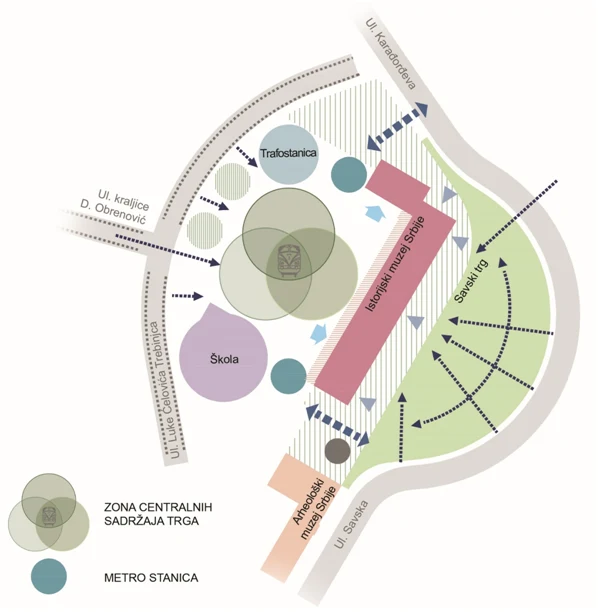
- Define the location for placing the Blue Train locomotive outside the zone of underground construction of Savski Trg Metro Station – the existing location of the locomotive is the area between the buildings of the Old Railway Station (Historical Museum of Serbia) and the Old Post Office (Archeological Museum of Serbia). The locomotive to be planned as a permanent exhibition element (museum exhibit) within development of the square.
- All spatial elements within the ground-level arrangement, such as sculptures, fountains, larger-scale urban furniture and other contents, must be designed and constructed with the minimum possible self-weight, in order not to endanger the reinforced-concrete structure of “Savski Trg” Metro Station located beneath the square. The maximum allowed imposed load of the reinforced-concrete cover slab of the station structure, as well as within a distance of 30 m from the outer edges of the station structure, amounts to 20 kN/m² (2 t/m²) (including all layers of the final finished level). Therefore, during design and construction it is necessary to ensure that the total loads remain within the prescribed limit values. In addition, the position of the locomotive should be defined in such a way that its static impact does not endanger the diaphragm walls and other load-bearing elements of the station.
Diagram of square contents distribution
Free and green areas
With the solution of free and green spaces it is necessary to create a spatial & functional and esthetic connection with the completed part of Savski Square in order to define the final form of open public space in the landscaping and architectural & urban sense. Also, by careful planning of spatial matrix, materialization and selection of contents it is necessary to create a multilayered connection of buildings of various styles and contents into a unique spatial unit.
In a wider sense, the Competition Solution should offer a way of connecting Savski Square with public open spaces in a wider surrounding, thus finalizing the process of spatial transformation and revitalization of a wider area into a modern, multifunctional urban center which represents connection of the central urban tissue with the Sava riverside area. Also, leveling of free areas should be adjusted to the surrounding area and contents.
Spatial matrix of free and green spaces of the square is conditioned by the position of the buildings oriented towards the square, existing and planned underground installations, position of metro system structures, etc.
When defining the layout and composition solution, fixed elements of Savski Trg Metro Station (entrances/exits, ventilation and emergency openings, etc.) should be completely integrated into the planned solution for the square. Positions of ventilation and emergency openings should be downloaded from the attached project documentation for the metro station. Emergency openings should be planned at the ground level, while grids of ventilation openings may be planned at the ground level or at a certain height (maximum 3m) if they are an integral part of the concept of square landscaping (e.g. within benches, planters, artistic installations and alike).
In compliance with the defined spatial restrictions of the site, in the Competition Solution the share of green spaces in direct contact with the soil should be as large as possible, taking into account that the part of Savski Square along Savska Street was reconstructed into a pedestrian zone with high percentage of green spaces and rich tree fund.
Boundary of the Competition Site encompasses the parts of the square area that are elaborated in the Preliminary Design of Landscaping in the Zone around the Stefan Nemanja Monument at Savski Square in the scope of the Belgrade Waterfront Project (CeS.TRA, 2021) and which are mostly completed:
- area between transformer substation, Street SAO 6 (Luke Ćelovića Trebinjca) and Karadjordjeva Street,
- area between the Old Railway Station (Historical Museum of Serbia) and the old Post Office Stare (Archeological Museum of Serbia).
With the Competition Solution on these square parts it is necessary to make connection with the design elements from the said project in order to form a spatial unit of a unique artistic expression.
Within the square it is necessary to define a location for communal waste disposal (for the needs of the Historical Museum of Serbia), along perimeter streets so that the route of waste collection vehicles is as short as possible. The area for waste disposal should be integrated into the concept of development of free and green spaces and harmonized with the urban equipment design.
Materialization
For development of the square follow the following recommendations for materialization:
- Applied materials should illustrate significance and representativeness of the space and buildings in the surrounding;
- Materialization and colors of the paved surfaces to be harmonized with the style and materialization of the completed part of Savski Square in front of the Old Railway Station Building (Historical Museum of Serbia);
- For paving the paths and the plateau use high-quality and decorative materials in harmony with the surrounding, safe for use during all weather conditions (e.g. care should be taken that materials do not radiate excessively, risk of sliding to be reduced, etc.);
- Surfacing at children playgrounds should be made using modern materials which might soften the impact of possible falls;
- Tactile paving and other technical solutions must enable movement of group of users with special needs;
- Foundation of sculptural contents, furniture and other structures shall not be in conflict with metro station solution;
- Consider visual division of different traffic modes using different surfacing (materialization and colors), and directing the flows by low and high greenery, elements of urban furniture.
Plant material:
- Plan the zone of low vegetation in accordance with the planned depth of substrate and bearing capacity of the structure of the underground facility. Soil overburden in the zone of underground station cannot have vegetation which might imperil station box;
- Green spaces should be shaped so as to become visual symbols or accentuators in the space and future generators of different activities associated with the surrounding contents;
- Care should be taken of connecting with free and green spaces in the surrounding, and in particular with the completed part of Savski Square;
- Confirm the authenticity of the space by proper selection of plant material, integrate all planned contents, make additional visualization of the author/designer idea. Green spaces should be shaped so as to contribute to affirmation of ambience potentials of this public area in agreement with its character and intended use;
- For greening use decorative species of trees and shrubbery, flowers and lawns, organized in landscaping compositions aimed at accentuating the esthetic dimensions of the space. Use the species adapted to local environmental conditions (pollution, made ground, high level of underground water), with long vegetation period, strong fhytoncide and bactericidal properties, great resistance to urban dust and exhaust gases, highly decorative and attractive during a longer time period;
- Use of invasive species and species that may cause allergies is prohibited:
- Greenery composition solution, in addition to high functional and esthetic values, must provide visibility, passability, safety and good spatial view;
- Spatial distribution of greenery must enable visibility of the space and structures from all access directions;
- High plants to be planned outside the zone of underground parts of metro system facility;
- Observe the prescribed distances between buildings and installations;
- Plan functional connection with greenery in regulation of streets.
Equipping the area with urban furniture elements:
- Plan introduction of high-quality furniture of contemporary design matching the representative contents of culture and the square;
- In agreement with the spatial needs and possibilities, plan the following: benches, planters, trash cans, lump-posts, sculptures, water features, bicycle racks, directional signs, signalization, interactive boards, etc.;
- Equipment on children playgrounds should be compliant with the prescribed standards;
- Provide lighting of the square area, and direct light sources towards the ground. Harmonize planned solutions with the solutions applied to the reconstructed part of the square and the Old Railway Station Building (Historical Museum of Serbia). With decorative lighting it is possible to accentuate sculptures, water features, monument values, microambiences.
- For urban equipment which utilizes electricity, use new technical and technological solutions, in particular those from energy renewable sources.
Traffic solution – accesses and communications
For solving traffic flows in the scope of the Competition Site the following requirements should be complied with: